


I can’t tell you how many times I’ve heard a business leader say, “We’re too small for hackers to bother with.” A few months ago, one of our clients — a 60-person engineering firm — thought the same. Then one morning, their finance manager got an urgent email that looked like it came straight from the MD. The request was simple: make a quick payment to a “supplier.” It looked legitimate, but looks can be deceiving. Within hours, they’d transferred thousands of pounds into a criminal account. That’s how simple it is now.
As someone who has spent years helping businesses to manage their IT estates, I see this happen all the time – particularly to those that still believe they’re flying under the radar. I get it, when you’re running an SMB, cyber security feels like overhead, or something for the big players with bigger budgets. But the truth is, being small no longer keeps you safe. It makes you vulnerable. Attackers aren’t targeting names anymore: they’re targeting opportunities.
In this article, we’ll debunk the “too small to target” myth once and for all. I’ll walk you through why it persists, what’s changed in the threat landscape, and how SOC-as-a-Service (Security Operations Centre as a Service) gives businesses like yours 24/7 protection without the enterprise price tag or complexity. By the end, you’ll understand what a SOC actually does, why reacting after the breach is too late, and how to turn security from a cost into a genuine advantage.
–
What This blog Covers:
- The “We’re Too Small” Myth That’s Putting You at Risk
- What a SOC Really Does (Without the Jargon)
- Where SOC-as-a-Service Makes the Biggest Difference
- How SOC Became Accessible to Smaller Businesses
- What “Good Enough” Security Looks Like for SMBs in 2025
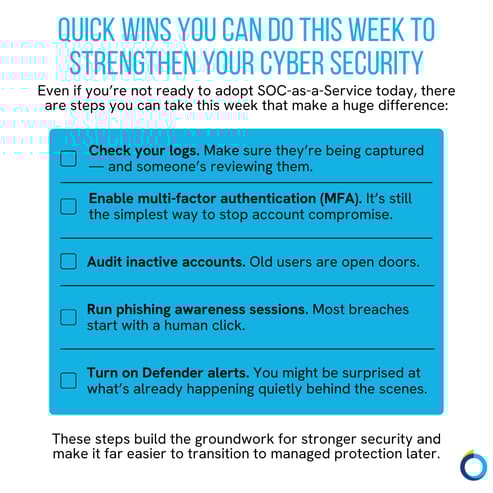
- What You Can Do Right Now
The “We’re Too Small” Myth That’s Putting You at Risk
For years, smaller organisations have believed that cyber criminals only go after the big guys. “We don’t have anything worth stealing,” they say. But that misconception is dangerous (and it’s costing businesses dearly).
The truth is, attackers don’t discriminate. They use automation to scan for weaknesses, like old software, unpatched systems, and weak passwords. So if you’re easier to breach than the next business, you’re a target. It’s that simple. Hackers aren’t thinking, “Let’s go after Company X.” They’re thinking, “Who’s left the door open?”
The other problem is perception. Many SMBs think cyber attacks are only about stolen data or ransomware. As Callum Archer explained in this article, criminals are increasingly going after supply chains: using smaller firms as entry points into larger partners. That’s why we’re seeing customers and suppliers demanding Cyber Essentials or ISO 27001 certification before signing new contracts.
In other words, not being able to demonstrate good cyber hygiene doesn’t just put your data at risk, but your commercial credibility at risk, too.
Why That Mindset Still Exists
So, why has this myth of “being too small to target” stuck around when the evidence is everywhere?
First, it’s about the perception of value:
When margins are tight, it’s easy to see security as a ‘nice-to-have’. It doesn’t directly drive revenue, so it gets pushed down the priority list. But every month you delay investing, the risk compounds.
Second, security feels invisible:
If you’ve never had an incident, prevention can be hard to justify. Instead of having a tangible win, you only have the absence of problems (which is technically a win if you ask me). It’s the same as insurance: you only realise its value when something goes wrong.
Third, complexity puts people off:
Even we seasoned IT pros get tired of the acronym soup — SIEM, SOAR, MDR, XDR – the list is endless. Most small teams don’t have time to research what’s necessary versus what’s noise.
And finally, capacity:
With most SMBs running lean IT departments (of one to four people), staying ahead of patching, phishing, and monitoring while also supporting the day-to-day can be likened to summiting Everest.
The last point is where I see the biggest risk: it’s not lack of care, but lack of bandwidth. Everyone’s trying to do everything, and cyber is always tomorrow’s job.
What a SOC Really Does (Without the Jargon)
Let’s strip away the jargon. A Security Operations Centre, or SOC, is your business’s digital watchtower. It’s a team of security analysts who monitor your environment — cloud, endpoints, email, and network — 24 hours a day, 365.
When they see something unusual, like a login from an unexpected location or a data transfer at 3 a.m., they investigate immediately. If they confirm it’s a threat, they contain it and stop it from spreading.
Here’s what happens behind the scenes:
- Monitoring: Collecting logs and alerts from your Microsoft 365, Defender, firewalls, and servers.
- Detection: Identifying anomalies and unusual activity.
- Response: Investigating, isolating, and containing threats before they cause damage.
- Improvement: Advising on how to prevent the same thing from happening again.
In English, a SOC turns reactive defence into proactive protection. It keeps a close eye on your systems even when your internal team has logged off. Without that, you’re relying on luck, which isn’t exactly a strategy.
Where SOC-as-a-Service Makes the Biggest Difference
Traditionally, a SOC was something only big enterprises could afford to build: racks of kit, expensive software, and a team of full-time analysts.
That’s just not realistic for most small businesses. And that’s where SOC-as-a-Service (SOCaaS) comes in. It gives you the same level of 24/7 monitoring, but delivered remotely by a dedicated team. You don’t need to hire staff or buy more tools; you simply connect your existing systems to their platform, and they take care of the rest.
Here’s why SOCaaS works so well for SMBs:
- You get always-on expertise: I’m talking about trained analysts watching your environment around the clock, ready to act the moment something looks suspicious.
- You use what you already own: Most businesses already have Microsoft 365, Defender, and a firewall. Those tools generate valuable data — the SOC just makes sense of it.
- You respond faster: If someone’s credentials are compromised at 2 a.m., the SOC isolates that account before you even know it happened.
- You meet compliance easily: It’s far easier to show auditors and partners that your systems are continuously monitored.
- You actually see ROI: The first time a SOC prevents downtime or data loss, it pays for itself.
In my view, it’s the most practical way for SMBs to get enterprise-grade protection without the enterprise price tag.
How SOC Became Accessible to Smaller Businesses
 When I first started in IT, having a SOC meant building a physical room full of screens, servers, and security staff. That world’s gone. Now, everything’s cloud-first. Microsoft has changed the game with Defender, Sentinel, and Entra. These tools generate rich telemetry (i.e., the signals that tell us what’s happening across every user and device).
A SOC-as-a-Service provider plugs into that data, analyses it, and takes action when needed. It’s a partnership:
- Microsoft collects the data.
- The SOC interprets and responds.
- You focus on running the business.
And because it’s all cloud-native, there’s no hardware to maintain or complex infrastructure to manage.
Why Doing Nothing Is the Most Expensive Decision
 We’re all friends here, so I’ll be honest: many businesses only call us after something bad has already happened. And by then, we’re in full damage control mode.
A single ransomware incident can lock your systems for days, or worse, corrupt your entire customer database. I’ve seen companies spend more trying to recover from one breach than they would have spent securing themselves for years.
But it’s not just financial. When clients or partners lose trust in your ability to protect their data, the reputational hit can be fatal.
I’ve worked with businesses that survived attacks and came out stronger, and others that didn’t reopen at all. The difference was in the detection and response time. Those who had real-time visibility minimised damage. But those who didn’t lost everything from data to customer confidence.
Advanced Security Is Easier (and Cheaper) Than You Think
 At this point, you might be wondering how much all of this is going to cost you. If so, you’re in good company: one of the biggest misconceptions I hear is that advanced security is out of reach. That you need big budgets and complex tools.
Not anymore. If you’re already using Microsoft 365, you have a powerful foundation: Defender for Endpoint, identity protection, and logging are already part of your environment. SOC-as-a-Service simply unlocks their full potential by adding human insight and round-the-clock vigilance.
You’re not buying new software; you’re buying time, expertise, and visibility.
Technology isn’t the challenge: it’s making sense of it all. A good SOC partner does exactly that, filtering thousands of alerts down to the handful that truly matter.
What “Good Enough” Security Looks Like for SMBs in 2025
Every organisation has a different appetite for risk, but there’s a security baseline every business should have by now.
Here’s what I consider “good enough” cyber security in 2025:
- 24/7 monitoring of all key systems — not just during office hours.
- Clear incident response plans so your team knows exactly who to call and what to do.
- Baseline compliance — at minimum, Cyber Essentials certification.
That’s the foundation. Once you’ve nailed that, you can start layering on more advanced protection.
The beauty of SOC-as-a-Service is that you can scale up as you grow. Start small, monitor critical systems, and expand coverage when you’re ready. Security evolves alongside your business.
The Real Threat Isn’t the Hacker — It’s Hesitation
 You don’t need a full-time security team to protect your business. All you need is the right visibility, the right expertise, and the confidence that someone’s keeping watch when you can’t.
The biggest threat to SMBs isn’t the hacker: it’s the belief that “we’re too small to matter.” That mindset is exactly what attackers exploit.
As an account director, I help SMBs modernise their IT and cyber security strategies at Babble. I’ve seen first-hand what happens when businesses wait too long, and how much stronger they become once they take control.
If you’re ready to find out how your security really stacks up, book a free cyber security audit with our team. It’s time to stop hoping you’re not a target, and start proving you’re protected.